
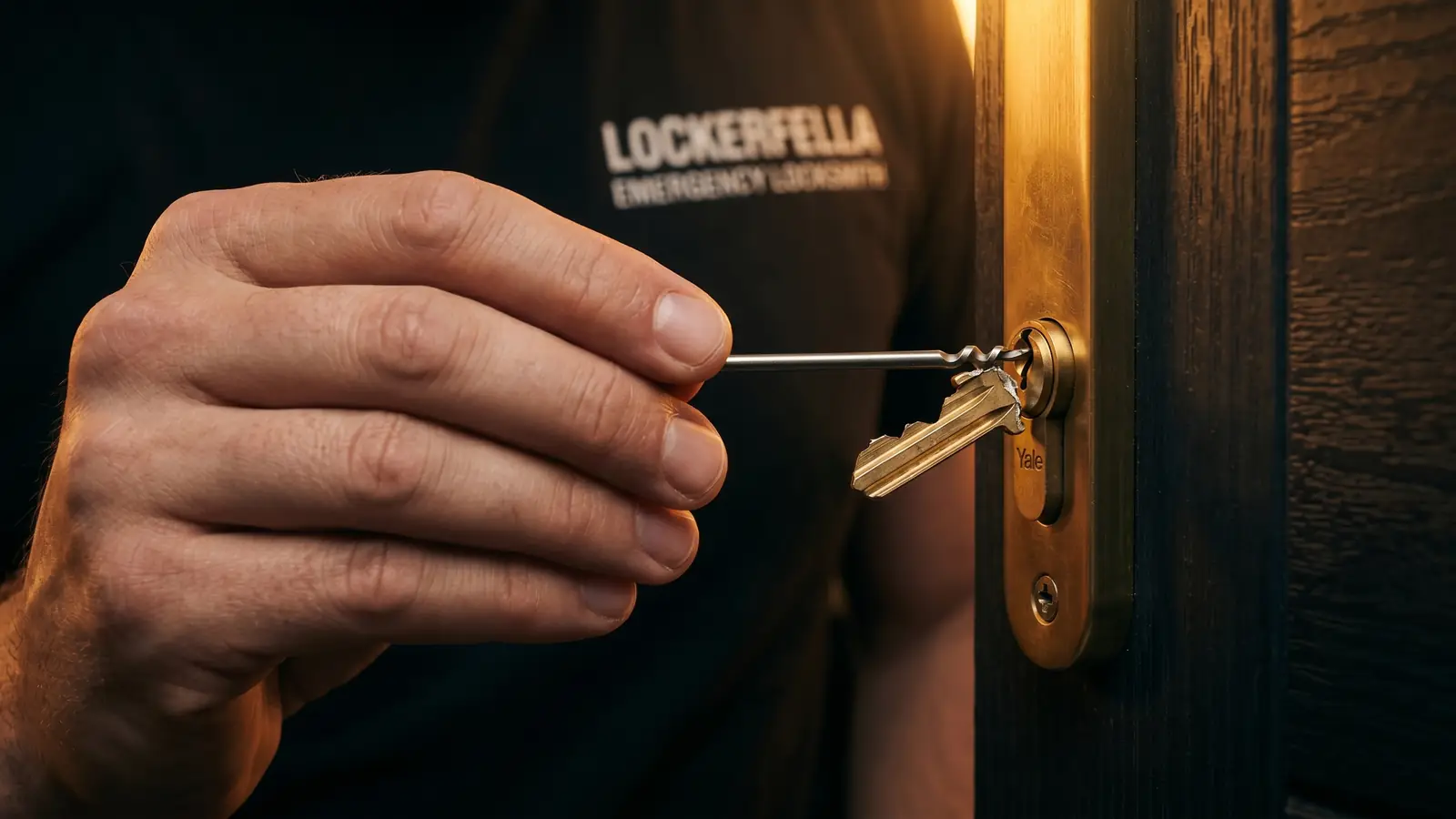
Snapped key extraction
Broken key in a lock? I'll get it out without replacing the lock.
Wolverhampton, Stafford and Cannock. From £90.
If your key has snapped in a lock, a locksmith can almost always extract the broken piece without replacing the lock. The job typically takes ten to twenty-five minutes and costs from £90 in my coverage area. Do not force the working part of the key against the broken stub. Each forced attempt pushes the stub deeper into the cylinder and turns a quick extraction into a full cylinder replacement.
- MLA Registered Member
- No Call-Out Fee
- No VAT Added
- Standard DBS Checked
- £1M Insured
- 12 months Guarantee
Can I remove a broken key from a lock myself? An honest answer.
A lot of people who Google a broken key in a lock are hoping they can get it out without paying a locksmith. The honest answer depends on exactly four things, set out below. If you read this list and the answer is "yes, this is fixable at home", I would rather you save the money than pay me to do a job you could have done with tweezers. If the answer is "no, this needs a locksmith", you know now, and you have my phone number.
-
If the broken stub is sticking out past the cylinder face by two or three millimetres or more...
A pair of fine-nose tweezers, eased straight back along the keyway axis (not twisted, not wiggled), can sometimes ease it out on the first attempt. One pull. If it does not come, stop.
-
If the stub is flush with the cylinder face...
Stop. Every wrong move from here pushes the stub deeper into the cam. A stub that has been forced past the pins turns a from-£90 extraction into a from-£90-plus full cylinder replacement. Phone me or send a WhatsApp photo and I will tell you what to do next.
-
If you have already tried to turn the working half of the key against the broken stub...
The cylinder is now under spring tension on the wrong side of the cam, and only an extractor tool inserted from outside the cam line resolves it without damaging the pins. This is the most common reason a £90 job becomes a £180 job. Stop turning. Step away from the door.
-
If your lock is a TS007 3-star anti-snap cylinder and the key snapped on the cylinder body (not the bow)...
That cylinder is faulty and may be covered under the manufacturer's warranty. TS007 cylinders are designed to break under sustained snap-attack, not under a normal turn of the key. Take a photo of the snap point before you do anything, then phone your home insurer or your original installer to check who pays for the replacement. I can do the swap and provide a receipt that supports the warranty claim.

What causes keys to snap in locks
The Keytek Forgetfulness Index (Locksmithing Census 2020-2025), which analysed 350,000 UK locksmith call-outs between 2020 and 2025, found that around one in five jobs are caused by human error rather than mechanical failure (source: Keytek Forgetfulness Index (Locksmithing Census 2020-2025)). A snapped key is the textbook example: a stiff lock that was telling you something for weeks, forced one too many times by the only key you had on you. These are the six causes I see most often on the doorstep.
- Stiff lock and a tired key. The lock has been getting harder to turn for months, the key has been wearing thinner with every use, and one cold morning the metal gives up. By far the most common cause.
- Cheap duplicate keys. Blanks cut at a high-street kiosk use thinner metal than the original. After six months of daily use the bow weakens and a snap is inevitable.
- Wrong key, wrong lock, at night. Door keys and gate keys feel similar in the dark. The bow rotates one click and meets resistance the key was never going to overcome.
- Frozen locks in winter. A cold lock is a tight lock. A frozen lock is a brittle key. Both at once, with morning haste on top, is a recipe for a snap.
- Misaligned uPVC doors. A multi-point gearbox that has dropped out of square stops the cam turning. The key takes the load instead. uPVC is the most common door type in the West Midlands and the gearbox is what fails first.
- TS007 anti-snap doing its job. A 3-star anti-snap cylinder is designed to break at a sacrificial line under sustained snap-attack. If yours snapped under normal use, the cylinder is faulty and may be covered under warranty.
How to remove a broken key from a lock: the actual extraction process
The visible steps below match the HowTo schema embedded on this page. Total time from arrival on the doorstep to lock tested and working is around twenty to thirty minutes for a clean break in a working cylinder.
-
Stop and look at the broken key
1 min
Look at the keyway. If the broken stub is protruding past the cylinder face by two or three millimetres or more, this might be a DIY job with fine-nose tweezers. If it is flush, stop. Every wrong move from here pushes the stub deeper into the cam and turns a quick extraction into a cylinder replacement.
-
Phone the locksmith with a photo
2 min
Send me a WhatsApp photo of the broken end of the key and the cylinder face. I will tell you on the phone whether this is something you can ease out yourself or whether I need to come and extract it with a proper tool. Quoting the all-in price on the phone is the trust check that separates a real one-man-band from a national call-centre number.
-
Light extraction with fine-nose tweezers (DIY-possible)
5 min
Only if the stub is sticking out. A pair of fine-nose tweezers, gripped on the protruding metal, eased straight back along the keyway axis (not twisted, not wiggled side to side). One pull. If it does not come on the first attempt, stop. Do not switch to a screwdriver or super glue.
-
Professional extraction with a key extractor tool
15 min
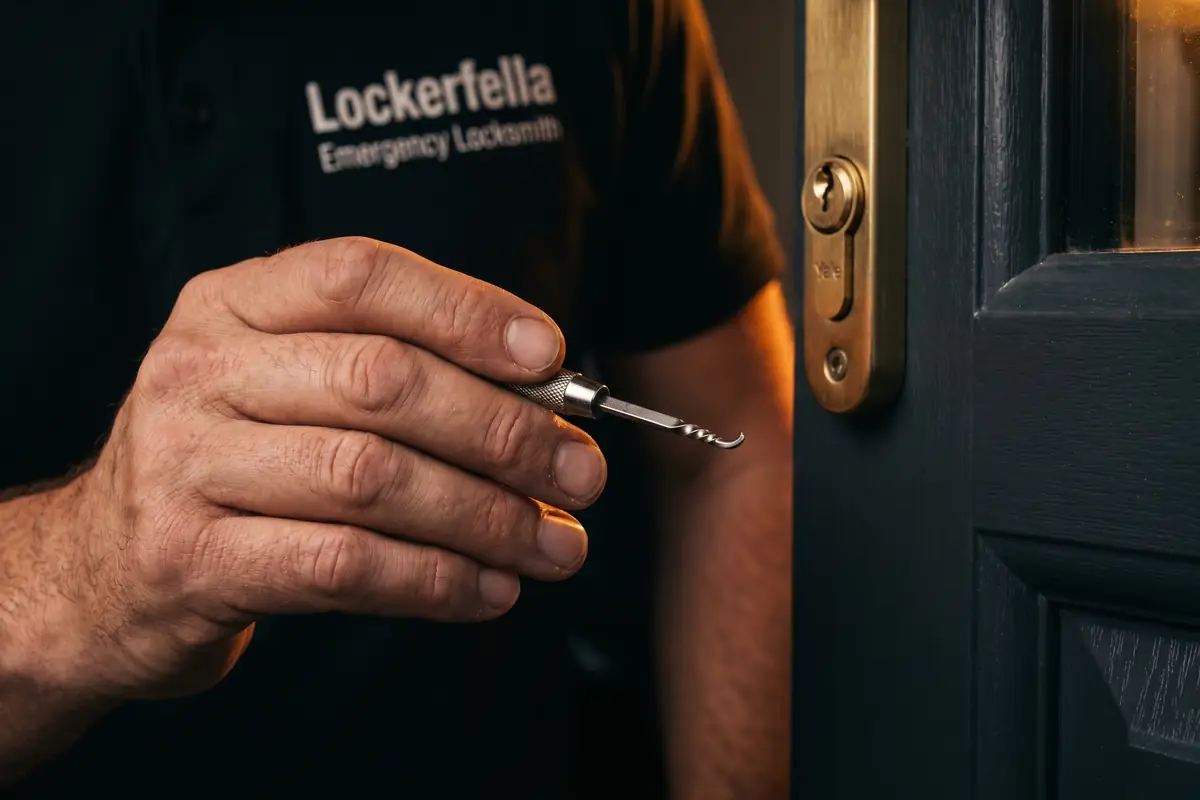
On site, I use a precision broken-key extractor (HPC KEX-1 or a Klein 50-piece set) inserted into the keyway alongside the broken stub. The spiral hook catches the cuts on the key, and a steady straight pull walks the fragment out without damaging the pins. Most extractions take ten to twenty-five minutes from arrival, including testing the lock with the spare key afterwards.
-
Drill and replace (last resort)
25 min
Only when the stub has been forced past the pins, the cam is jammed in the locked position, or an anti-snap cylinder has done its job and snapped at the sacrificial line. The cost moves from snapped-key extraction (from £90) to a full cylinder change (from £90 plus the cylinder). I tell you which case you are in before I start any work that costs you parts.
A common assumption
Most people assume a snapped key means buying a new lock. It almost never does. The cylinder is unharmed nine times out of ten. Extraction takes ten to twenty-five minutes and the same lock keeps working with the same set of keys, minus the one that broke.
Recent broken-key call-outs
Three recent extractions across the West Midlands and south Staffordshire. Real people, real prices on the receipt, sat next to what a national locksmith number would have quoted for the same job. Customer details lightly anonymised at their request.
-
Wednesday 27 May 2026 at 9.40am · Wolverhampton
Mrs Asha P., Wolverhampton
Yale euro cylinder on the front door, key snapped flush with the cylinder face as she locked up for the school run. No spare on her.
A national number quoted the customer £260Paid to me £95On her doorstep 25 minutes later. Brass stub extracted with a HPC spiral hook in under two minutes, no damage to the cylinder. Spare key cut from the half she had with her, on the van. Back on the school run before the next bell.
-
Monday 4 May 2026 at 7pm (bank holiday) · Stafford
Mr Tom H., Stafford
TS007 3-star anti-snap cylinder on the back door. Cylinder body had snapped at the sacrificial line, key snapped in the front half, both halves in his hand.
A national number quoted the customer £395 OOHPaid to me £185Anti-snap doing exactly what it is designed to do under attack. Replaced with a like-for-like Avocet ABS 3-star cylinder from the van. New keys cut from his spare, keyed alike to the front door. 35 minutes from doorstep to working lock.
-
Sunday 24 May 2026 at 10.30am · Cannock
The Cooper family, Cannock
Back-gate padlock, dad's key snapped clean in two while he was unlocking it on a frosty morning. Wife and the two kids waiting on the path with the bins.
A national number quoted the customer £180Paid to me £90Cold lock, tired key, more than the metal could take. Padlock unlocked with a tension wrench in three minutes, broken half extracted, padlock kept (it was a Squire that retails for £40 and was perfectly serviceable). Two new keys cut from the bow half. No call-out fee.
Cost figures cross-checked against the Master Locksmiths Association, whose published guidance is that "a broken key that has just been broken by user error, in a working lock, should take no longer than half an hour to remove" at "around £85" (source: Master Locksmiths Association). My from-price of £90 sits in line with that figure.
What customers say about extractions
Verified Google reviews from real customers across Wolverhampton, Stafford, Cannock and the surrounding villages.

Absolute lifesaver! I had to call Sean incredibly early in the morning because my children and I were trapped inside our house by a broken uPVC door lock. Sean answered the phone directly with no delay. He arrived even quicker than his estimated time and did the job very quickly and professionally. Best job, highly satisfied and so much respect for his service! Highly recommend.

It was my pleasure Khabat. Thankyou so much for the lovley review. Sean ☺️

Had an issue with lock this morning Sean came out within the hr, very professional, reasonable and discussed what needed replacing before carrying out the necessary work. Friendly, reassuring and totally trustworthy. Cant recommend Locker fella enough, thanks Sean⭐ ⭐ ⭐ ⭐ ⭐ Burntwood area 👍
Thankyou for your review Samantha, it really is appreciated! Have a beautiful day. Sean ☺️

Excellent service (Wolverhampton / coven) arrived quickly, very knowledgeable and did a great job would not hesitate to call again.
Thankyou for your review Louise! It's really appreciated. Have a fantastic holiday. Sean - Lockerfella Locksmiths 24/7.

Absolutely fantastic! Came out to us in Stafford for an emergency lock repair and Sean was here in less than a hour! Sean is so polite and easy to have a chat to. Would definitely recommend to absolutely anyone! Best man for the job! Thank you ever so much again.
My pleasure guys. I'm glad I could help you both out. Sean - Lockerfella Locksmiths 24/7.

We just moved house and wanted to get the front locks change for added security. Sean did the job fast and efficiently. The new keys were in our hands in no time. Highly recommend Lockerfella Locksmith to anyone.
Thankyou for your review Patrick. It was my pleasure. Sean - Lockerfella Locksmiths 24/7

I got in touch with Sean as our back door lock had broken and we couldn’t lock the door at all. Sean came over really quickly and sorted the problem, he’s a lovely guy really chatty and friendly, and the communication was great. I would absolutely not hesitate to use him again in the future, thanks so much Sean!! Frankie Penkridge
Thankyou so much for the amazing review Frankie! It was my pleasure helping you today. Sean - Lockerfella Locksmiths 24/7.

Sean came to change our locks whilst we were on holiday and found that our pet sitter couldn’t get into the house. Even though we were far away Sean communicated really well and worked with our pet sitter to make sure the house was safe and secure and that the pets could be looked after. What could have been a very stressful situation was made loads easier with Sean’s fantastic service. I’d definitely recommend!
Thankyou for your review Hannah. It was my pleasure to help you and your pet sitter today in Norton Canes. Enjoy the rest of your holiday. Sean ☺️

Amazing service! Sean was brilliant, got the job done in no time, arrived on time and very nice chap. Highly recommend him! Thank you!
Thankyou for your review Anna! Pleasure assisting you and your mum in codsall today with your emergency call out. Lockerfella Locksmiths ☺️
Prices
From-prices for broken-key work
The figures below are the floor prices for the jobs I am called to most where a key has snapped or is stuck. They include attendance, diagnosis and labour, with no separate call-out fee. Where a new part is needed, a standard part is included in the from-price and any upgrade is itemised so you can see exactly what each one cost. I quote the all-in figure on the phone before I leave the van. The full price list with covers and affects sits on the dedicated pricing page.
- Snapped key extraction (cylinder kept) from £90
- Cylinder replacement (when extraction is not possible) from £90
- Out-of-hours emergency (6pm to 8am, weekends, bank holidays) from £170
- Spare key cut from the broken halves (on the van) from £8
No VAT added on top. No call-out fee on any of these. Where a new part is needed, a standard part is included in the from-price and any upgrade is itemised on top. See the full price list and what each one covers →

About the locksmith
The locksmith answering your call
I'm Sean Hamilton. I run Lockerfella as a one-man-band. If you ring me with a snapped key, the phone rings on me, I quote the all-in price for the extraction on the phone before I leave the van, and the figure on the card machine matches the figure I said on the phone. No call-out fee on the extraction. No upsell to a new lock you don't need.
- 30+ years fascinated by locks. I've been picking, stripping and studying locks for the love of it for over 30 years. Lockerfella is what happens when a lifelong interest in how locks work becomes the day job.
- Trained and certified. Certificate of Locksmith Skills from A'Jam Locksmiths covering cylinder, mortice, padlock, wafer and euro lock picking, plus re-keying and mortice bypassing.
- Standard DBS checked, £1M insured, 12 months workmanship guarantee. Redacted DBS and insurance certificates are published on the About page, with originals available to view in person before work starts.
- One man, one van, one phone number. The phone rings on me directly. No call centre. No third-party fitter. If I quote you a price, that's the price you pay.
Common questions about broken-key extraction
Straight answers about what an extraction involves, what it costs, and when you can fix it yourself.
Can a locksmith remove a broken key without replacing the lock?
Yes, almost always. About nine times in ten the cylinder itself is unharmed when a key snaps. The broken half is just wedged in the keyway. I pull it out with a fine-nose key extractor (HPC KEX-1 or similar), clear any residual pin debris, and the same lock keeps working with the spare key. The cases where the cylinder does need replacing are usually anti-snap cylinders that have snapped on the cylinder body (those are doing their job and the body has to be swapped), or locks where someone has forced the working half of the key against the broken stub and damaged the pins. Those I tell you about on the doorstep before I start.
How long does it take to extract a snapped key?
For a clean break in a working lock, ten to twenty-five minutes from when I get to the door. The Master Locksmiths Association says half an hour for a typical user-error break, which matches what I see in practice. Anti-snap cylinders that have done their job take longer because the cylinder body needs swapping after the extraction. The big variable is whether the stub is flush with the keyway face or sticking out. A stub that protrudes by two or three millimetres is a minute's work with the right tool. A stub that is flush against the cam is fiddlier and may need the cylinder out first.
What causes keys to snap in locks?
A stiff lock and a tired key, ninety per cent of the time. The lock has been getting harder to turn for months, the key has been wearing thinner with every use, and one day you put a bit more weight on it and the metal gives up. Cheap duplicate keys cut at high-street kiosks are the worst offenders because the blanks use thinner metal than the original. Other causes I see often: forcing the wrong key in at night (door keys and back-gate keys feel similar in the dark), frozen locks in winter, and misaligned uPVC doors where the user is forcing the cylinder to turn against a gearbox that has dropped out of square.
Should I try to remove the broken key myself?
Only if the stub is sticking out past the keyway face by two or three millimetres or more. In that case fine-nose tweezers can sometimes ease it out. If the stub is flush with the keyway face, stop. Every wrong move pushes it deeper into the cylinder, and a stub that has been forced past the pins turns a £90 extraction into a £90-plus full cylinder replacement. Do not try to turn the working half of the key against the broken stub. Do not use super glue. Do not poke a screwdriver in there. Phone me, send me a photo on WhatsApp, and I will tell you honestly whether it is a DIY job.
Will I need a new lock, or can the cylinder be saved?
In most cases the cylinder is saved. The broken metal is just lodged in the keyway, not damaging the pins or the cam. Once it is out, the lock works exactly as it did before with the spare key. The cases where I do need to fit a new cylinder are: an anti-snap cylinder that has snapped at the sacrificial line (the body has to be replaced because that is the design), pin damage caused by forcing the working key against the broken stub, and rare cases where the broken metal has been pushed deep enough to jam the cam past the keyway. I tell you which case you are in before I start any work that costs you parts.
Can you cut a new key from the broken pieces?
Yes, if you have both halves and the breaks are clean. I take the two pieces, line them up on a key blank of the same profile (Yale 1A, ABUS, Avocet, whichever your lock uses), and cut from the silhouette. The cost is whatever a single cut key is, on top of the extraction. If you only have the half that was on the bow and the other half is still in the lock, I extract the lock half first, then cut from the combined silhouette. If neither half is usable (a high-security key with restricted profile, or both halves badly mangled) I decode the lock on the van and cut a new key directly. Either way, you leave with a working key.
Does WD-40 help free a stuck or broken key?
No, and using WD-40 in a door lock makes the lock worse over time. It dries out the lock's own dry lubricant and leaves a sticky residue that grit clings to. The right product is a graphite spray or a dry PTFE lubricant, both available from any hardware shop or screwfix.com for a few pounds. That said, lubricant on its own does not free a key that has already snapped. The broken half is wedged on the cuts and the pins, not on a film of friction. The fix is mechanical extraction, not chemical. If the key is stuck but not yet broken, a single spray of graphite into the keyway and a gentle wiggle is the right first move.
Ready when you are
Key snapped? Send me a photo on WhatsApp.
I'll look at the photo and tell you on the phone whether you can ease it out yourself with tweezers or whether I need to come out. No call-out fee. No deposit. No surprises.
Page last reviewed: . Reviewed by Sean Hamilton, the locksmith behind Lockerfella, under our editorial standards.